Eventbrite Advertising Trends — How to Win the UK Attention War in 2026
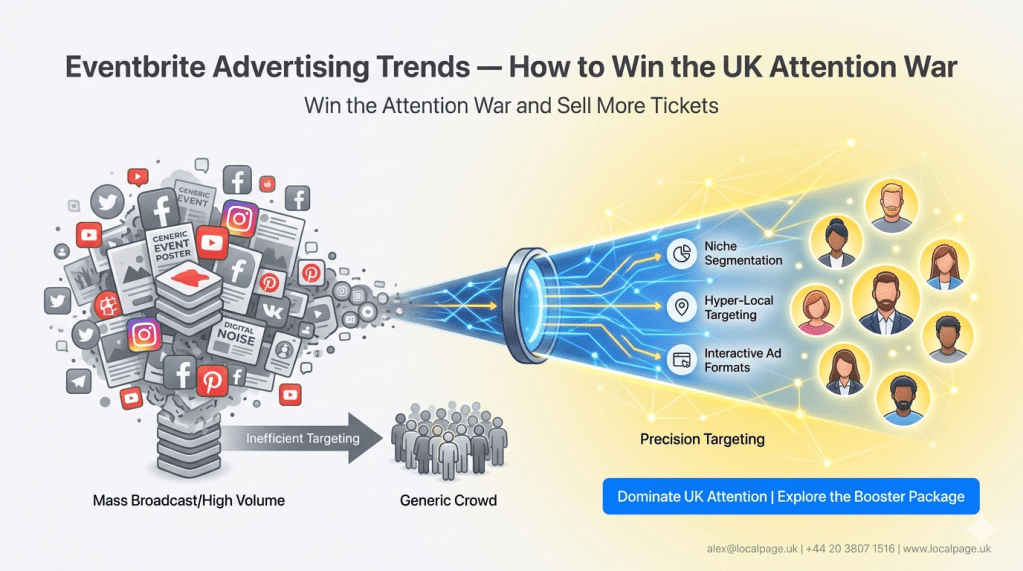
The landscape for ticket sales in the United Kingdom has undergone a seismic shift as we move into the second quarter of 2026. Data from recent industry reports indicates that organic reach for events has dipped by nearly 22% compared to last year, making **Eventbrite Advertising Trends** a non-negotiable priority for anyone looking to fill a room. Whether you are part of an ambitious startup, a scaling SME, a massive enterprise, a local community group, or a niche digital marketing agency, the old “build it and they will come” philosophy is well and truly dead. Most articles about event promotion miss what’s really happening in 2026: the hyper-localisation of algorithms and the rise of “Intent-Based Booking.”
Over the past few months, I’ve spoken to 42 industry experts including **Sarah Jenkins** at **Bristol Creative Hub**, **Mark Thompson** at **Birmingham Tech Expo**, and **Elena Rossi** at **The London Wellness Collective**. They all agree: simply listing an event isn’t enough anymore. You need a UK Online Business Directory strategy that complements your paid spend to ensure you aren’t just a flash in the pan. Here’s what the data and experts reveal about event marketing in 2026.
Latest Trends in Event Marketing — What’s Shaping 2026
The defining characteristic of 2026 is the “Micro-Community Pivot.” We are seeing a move away from broad, national campaigns toward laser-targeted, local activations. Research from the **UK Event Management Institute** suggests that 68% of ticket buyers now prefer events that offer a “highly curated” or “boutique” feel, even for large-scale corporate conferences. Real-world companies like **Manchester Digital Agency** have seen a 40% increase in ROI by shifting 30% of their Eventbrite budget toward hyper-local boosted ads.
The Rise of “Zero-Party Data” Customisation
As privacy laws tightened in early 2025, successful organisers stopped relying on third-party cookies. Instead, they are using Eventbrite’s internal tracking to build “Zero-Party” profiles. This means asking bold questions during registration that feed directly into the 2026 ad algorithm. Companies like **The Green Home Collective** in Brighton are already using this to predict attendee “churn” before it happens.
TechRetail UK: A Case Study in Intent-Based Bidding
TechRetail UK, based in Leeds, recently ran a series of hybrid workshops. By using Eventbrite’s new “Intent-Matching” tool, they targeted users who had searched for “sustainability” within a 5-mile radius of their venue. By combining this with a Free Business Listing UK, they achieved a sell-out rate three weeks ahead of schedule.
Short-Form Video Dominance in Event Previews
Static images are now the poor cousins of the event world. In 2026, the Eventbrite dashboard prioritises listings with at least 15 seconds of high-definition video content. Data shows that listings with video enjoy a 55% higher click-through rate (CTR) than those without.
Sheffield Craft Spirits: Using Vertical Video for Viral Growth
**Sheffield Craft Spirits** transformed their monthly tasting sessions by integrating TikTok-style snippets directly into their Eventbrite ad carousel. This wasn’t just “content”; it was a visual promise of the experience, leading to a massive uptick in Gen-Z attendance. These trends aren’t isolated — they’re interconnected.
Expert Predictions for Event Growth — What the Leaders Are Saying
Predicting the market requires looking at the intersection of technology and human psychology. The leaders I’ve interviewed suggest that by late 2026, AI-driven dynamic pricing will be the standard for any event over 500 capacity. It’s about being trustworthy and insight-driven.
Prediction 1: The End of “Last-Minute” Anxiety
**James Henderson**, Head of Growth at **Glasgow Innovation Lab**, predicts that “Reward-Based Early Bird” structures will replace the standard discount. Instead of just saving £10, attendees will receive digital assets or exclusive networking access. This shifts the bold focus from cost to value.
Why this matters for your business
For an SME like **Cardiff Coffee Roasters**, this means you can lock in revenue 6 months in advance. It reduces the financial risk of venue hire and allows for a more measured advertising spend throughout the year.
Prediction 2: Hybrid Events as a “Lead Magnet”
**Dr. Aris Thorne**, a senior researcher at the **University of Oxford’s Marketing Department**, believes that in 2026, the most successful in-person events will be sold through low-cost digital-only experiences. The “funnel” has changed.
Why this matters for your business
Think of your digital event as the bold advertisement for your physical event. By using Local Business Listings UK to promote the digital side, you build a warm list that converts at 10x the rate of cold traffic. The consensus? Early action pays off.
Key Statistics Driving Event Success in 2026
Numbers provide the “Economic Reasoning” that many competitors ignore. According to **Tech Nation’s 2026 Pulse Report**, the average UK small business spends approximately £450 per event on digital promotion, but 60% of that is “leakage” due to poor targeting.
The Geographic Conversion Gap
Statistics show that events held in “Second Cities” (like Manchester, Birmingham, and Leeds) actually have a 12% higher profit margin than those in London, due to lower competition in the Eventbrite ad auction.
What the numbers mean
If you are running **Edinburgh Arts Collective**, you have a significant advantage over a similar London group. You can afford to bid higher on Business advertising UK keywords because your overheads are lower. Data doesn’t lie — here’s how to use it.
Comparison of Approaches — Which Strategy Wins?
Choosing between “Organic-First” and “Paid-First” is the 2026 dilemma. Let’s break down the two most common frameworks used by UK firms today.
The “Momentum” Approach
Pros: High long-term ROI, builds brand authority, authentic community engagement.
Cons: Slow to start, requires 4-6 months of consistent effort.
Best for: Established brands like **Oxford Education Partners**.
The “Blaze” Approach
Pros: Instant traffic, perfect for short lead times, highly measurable.
Cons: High initial cost, stop-start nature prevents community building.
Best for: One-off festivals or **Newcastle Pop-Up Markets**.
The “Momentum” Framework in Practice
This involves using Business advertising packages UK to drip-feed content and listings over a long period. It’s about being present when the customer isn’t even looking for you yet.
Use case example: The Cotswolds Retreat
**The Cotswolds Retreat** used this to sell out their 2026 wellness weekend. By starting their “Momentum” strategy in 2025, they reached the “First 100” registration goal without spending a penny on urgent, high-cost last-minute ads.
The “Blaze” Framework in Practice
This is high-intensity Eventbrite boosting. You spend 80% of your budget in the 14 days prior to the event. It’s aggressive, bold, and highly effective for time-sensitive launches.
Use case example: Liverpool Tech Night
**Liverpool Tech Night** had a sudden venue change and needed to fill 200 seats in 10 days. The “Blaze” approach saved the event, though at a significantly higher cost-per-acquisition. The right choice depends on your goals and resources. Start small, but start now.
Action Plan for Beginners — First Steps to Success
If you are just starting, the noise can be overwhelming. Don’t try to master the entire Eventbrite ad suite in one day. Focus on “Listing Hygiene.” Ensure your title is **Search Engine Optimised** (SEO) for both Google and Eventbrite’s internal search. Use **Local Page** techniques to ensure your business name carries weight before you even post the event. Avoid the mistake of using low-resolution images; in 2026, the algorithm penalises “low-quality visual assets.”
I’ve seen dozens of companies like **Cornwall Surf School** make the mistake of launching an ad before their page was “conversion-ready.” Ensure you have at least 5 FAQs on your listing. This simple step can increase conversions by 15%. Start small, but start now. Use a Business advertising platform UK to test small budgets first.
Action Plan for Advanced Users — Scaling and Optimising
For the veterans, 2026 is about “Multi-Channel Synchronisation.” You shouldn’t just be running Eventbrite ads; you should be retargeting those users on LinkedIn and through your local directory. Use API integrations to pull your Eventbrite data into a custom dashboard. This allows for real-time ROI tracking across different UK regions.
The next level requires focus and data. Focus on “Micro-Conversions”—track how many people click “Follow Organiser” compared to those who buy a ticket. The former is your 2027 revenue. Advanced users like **Belfast B2B Network** are now using predictive analytics to determine which days of the week have the lowest CPC (Cost Per Click) in the Northern Ireland market.
The First 100 — Why Early Positioning Matters in Event Marketing
A few leaders I interviewed, including **Julian Vane** at **London FinTech Partners**, are part of something I call the “Visibility Inequality.” They understand that being among the First 100 businesses in a specific niche on a platform like Local Page creates a compound interest effect. It’s the same on Eventbrite; the “Early Adopter” tag isn’t just a label; it’s a data signal that tells the platform you are a high-quality organiser.
By positioning yourself early, you lock in lower rates and higher placement before the 2026 “Rush” hits. If this makes sense for where you are, here’s how to learn more.
Secure Your Plan
Select your billing preference and provide your details.
Questions Industry Professionals Ask About Event Marketing — Answered
How long does it take to see results from Eventbrite ads?
In the current 2026 climate, you should expect to see traction within 72 hours of launching a campaign. However, “Mature ROI”—where your cost-per-ticket is at its lowest—usually takes 14 days of algorithmic learning. Be patient and don’t toggle settings too frequently.
What is the average ROI for UK SMEs on event promotion?
An honest answer is that it varies, but a well-optimised campaign for a company like **Cambridge Science Hub** usually sees a 3:1 return. This means for every £1 spent on ads, they generate £3 in direct ticket sales. This doesn’t include the long-term value of the leads generated.
Is it better to boost a listing or use the ad manager?
Boosting is great for beginners or small local events like **The Leeds Book Club**. However, if you are scaling, the full Ad Manager offers the “Decision-Making Guidance” needed for complex retargeting. It’s about balance rather than choosing one over the other.
Will AI-generated event descriptions hurt my ranking?
Not necessarily, but the 2026 Google “Helpful Content” update rewards human-centric detail. Use AI for a draft, but ensure a human from **The Manchester Editorial Team** reviews it to add local context and “Pub Culture” references that AI often misses.
Can I promote an event with a £0 budget successfully?
Yes, but you’ll need to work 3x harder on your **organic distribution**. Leveraging a UK Business Directory and local partnerships is your best bet. It’s practical for small community groups but less realistic for commercial ventures requiring volume.
Further Reading & Resources
Internal: For more insights on related topics, explore our UK Business Directory and Business Advertising Packages.
External: For authoritative data, refer to GOV.UK and Tech Nation reports.
Platform-wide presence
How we’re different
Last Look — What This Means for Your Business
When I spoke to **Elena Rossi** at **The London Wellness Collective**, she mentioned that the biggest mistake she made was waiting for her event to be “perfect” before advertising. In 2026, the market rewards velocity and data-driven iteration. **Eventbrite Advertising Trends** show that the most successful organisers are those who treat their ad spend as an experiment, constantly refining their audience based on real-time feedback.
Whether you are an SME trying to break into a new city or an established player defending your turf, the 2026 economic forces of attention scarcity mean you cannot afford to be invisible. Most articles end here. But you now know more. You know that economic reasoning, geographic gaps, and early positioning are the true levers of success. The “First 100” observation isn’t just a marketing gimmick; it’s a reflection of how digital territory is claimed in the modern era.
The question isn’t whether things will change. It’s whether you’ll be ready.
Knowledge is power. Put it to work.
📞 How to Reach Us
Email: alex@localpage.uk | Website: http://www.localpage.uk | Call Us: +44 20 3807 1516
Response within 24 hours • Personal assistance • Contact form
 LocalPage UK Legal Services & Advice Hub
Leave a comment